The Mill complex which includes Whiteleys Mill built in 1883 and Harrington Mill built in 1885 – 1887 was said at the time to be the largest lace factory in England.
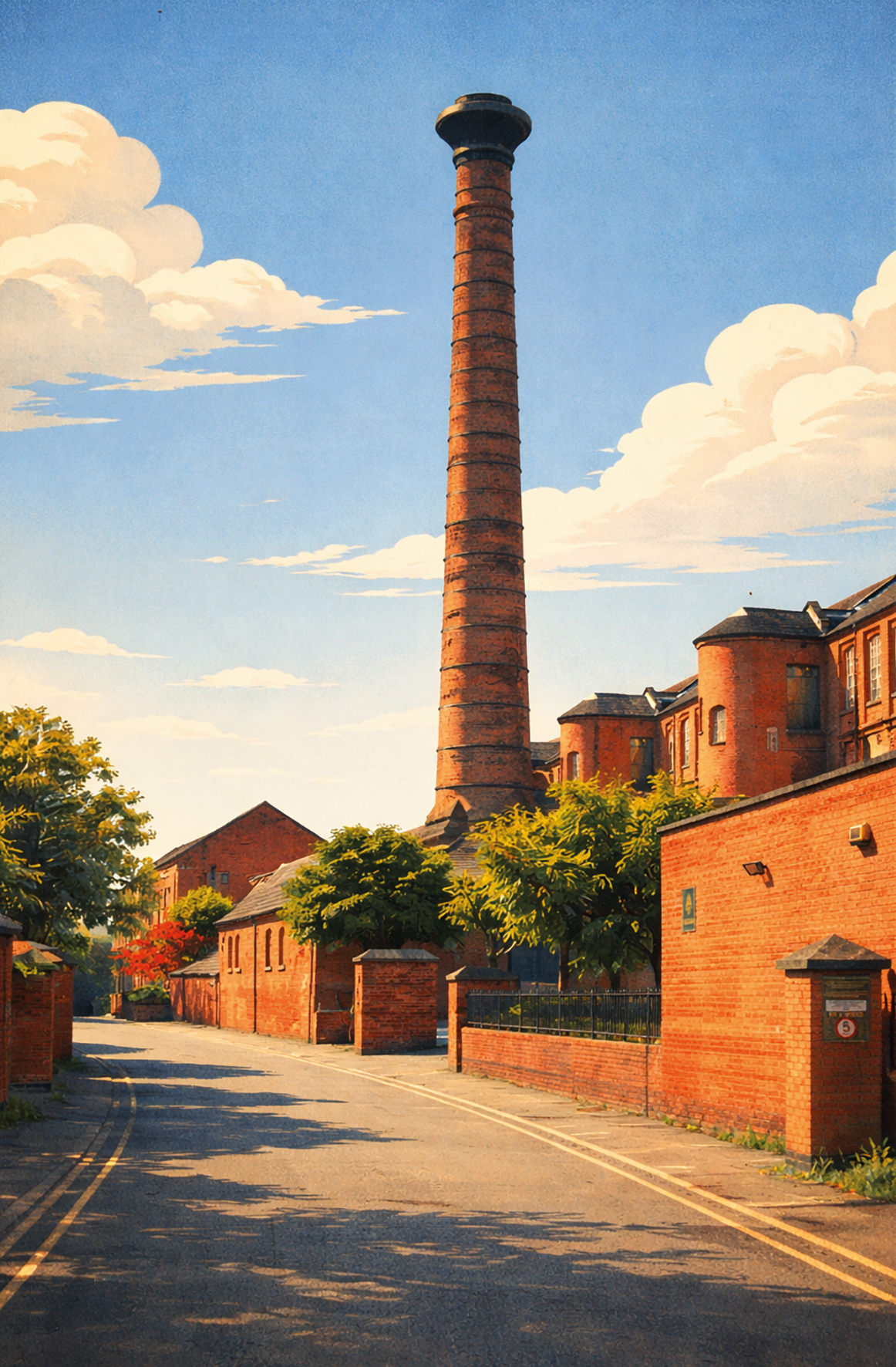
The feature of the mill is the old factory chimney, now unused, with its cast iron‘Onion’ top, one of only three left in the country.
The original shareholders, all local dignitaries, were William Arthur and Elizabeth Ann Whiteleys, John Piggin and Mary Fearfield, Thomas Pegg, Evington Dalby, William Thurman and Samuel Smith. George Fletcher was the first Secretary. Later shareholders were Ernest Terah Hooley another notorious local resident and John Syson, Frederick William Brecknock, Walls and Longden and John Davys all well known in the local lace trade.
Early Directors meetings were held at the Royal Hotel in the High Street, Long Eaton.
The original Solicitors to the Company were Joseph Wilson and Co established in Long Eaton in 1880. In 1916 Mr. Sam Thomas an associate of Joseph Wilson established his own firm S.J.B. Thomas & Co (now known as Thomas Solicitors).A partner in this firm has been Secretary to The Harrington Factory Co Ltd since 1st July 1932 since the death of Mr.W.B.Smith.
The first Bankers to the Company were Samuel Smith & Co of the Market Place, Long Eaton probably the forerunner of the National Provincial Bank now part of the National Westminster Bank.Their branch at South Parade, Nottingham is still known as Smiths Bank Branch.
Samuel Smith lived at Bridge House, Derby Road, Long Eaton which is now the offices of the Department of Technical Services, Erewash Borough Council on the corner of Cranmer Street.
One of the original shareholders, Evington Dalby lived at Granville House, Derby Road, Long Eaton now the Sportsman Public House.
The Mill complex was of course first built as a lace factory with power provided through shafting on each of the four floors connected through 6 feet diameter pulley wheels and ropes to the adjacent engine house.The engines were driven by steam provided by coal fired boilers, the coal being delivered to a wharf by barges on the adjacent canal.The rope race chambers extend the full height of the building and the pulleys are still in position at the centre of each mill.
The boilers also provided general steam heating throughout the mill also the ovens used to heat the lace bobbins some still in existence in the access turrets.
Gas fired heater are now provided in each of the separate units controlled by the occupants.
Lighting was originally provided by gas. This has now been superseded by electricity and three phase electricity is now provided to all parts of the building.The boilers and steam engines are now removed, the boiler house having been converted to a letable unit.
The building is now protected from fire by an automatic water sprinkler system originally installed in 1912 but upgraded with electric booster pumps and a large water tank in 1994.
REFURBISHMENT
Some years ago (around 1990) all the old sheds and superfluous buildings were removed and the yards resurfaced ensuring easy access by the largest of articulated vehicles to all parts of the premises.All the overhead telephone wires were removed and BT provided a new underground distribution system to all parts of the premises.
The refurbishment of the building included the cleaning, sandblasting and repointing of the external brickwork and the replacement of all damaged cast iron window frames, cast iron gutters and downspouts, returning the building to the way it looked over a century ago.
A modern feature is the introduction of planted areas with shrubs and trees and new railings along the canal side.This area, at one time the coal wharf, has now been used to provide additional car parking, a use not even thought of at the turn of the century.